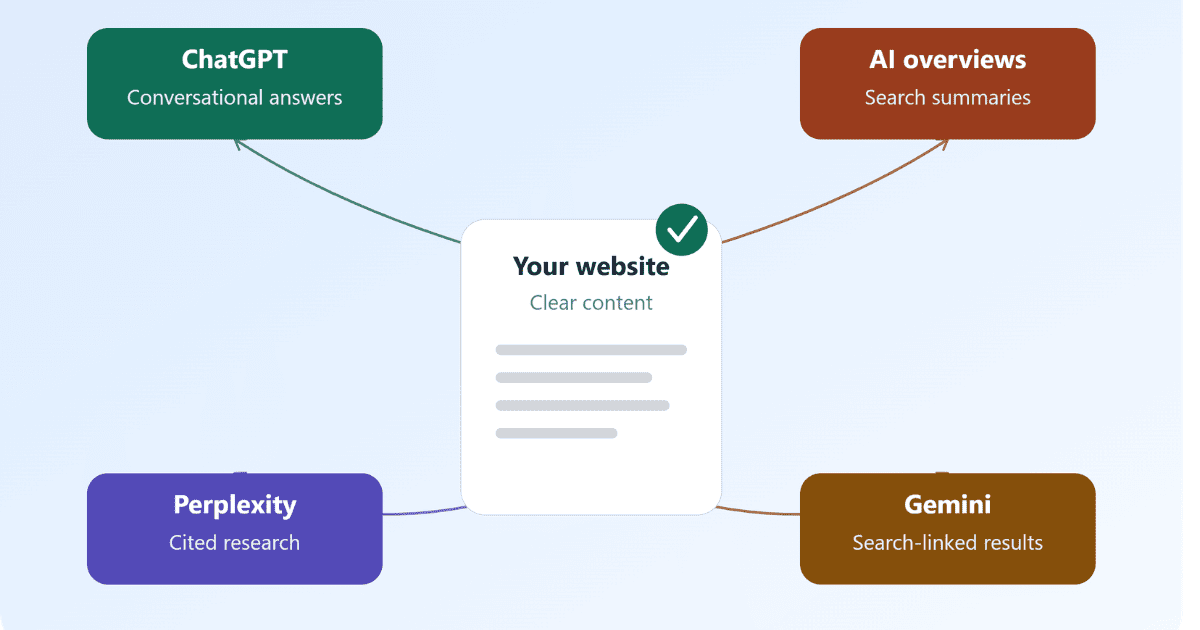
Search is changing fast. A few years ago, people only typed questions into Google. Now, many of them ask ChatGPT, Google AI Overviews, Gemini, Claude, or Perplexity instead. These AI tools give quick answers, often without sending people to a website at all.
This is a big shift for small businesses. If your website is not set up the right way, AI tools may never mention you — even if you offer exactly what someone is looking for.
In this guide, you will learn what AEO really means, why it matters for your business, and simple steps you can use today to show up in AI search results. We work with small businesses every week, helping them get found on Google and on AI tools like ChatGPT, and this guide is based on what we have seen actually work.
Let's get started.
What Is Answer Engine Optimization (AEO)?
AEO means writing your website content in a way that AI tools can easily read, trust, and use to answer people's questions.
Normal SEO helps Google show your website as a link in search results. AEO does more. It helps AI tools like ChatGPT, Gemini, or Perplexity understand your business and mention you directly in their answer.
Sometimes the person never even clicks your website. AI tells them about you.
Here is a simple example. Someone asks ChatGPT, Who is a good electrician near me? AI looks for clear answers, simple language, and real proof that a business is trustworthy. If your website has this, AI is more likely to recommend you. AEO is not about tricks. It is about being clear enough that AI wants to use you as a source.
Why Ranking on ChatGPT and AI Search Matters
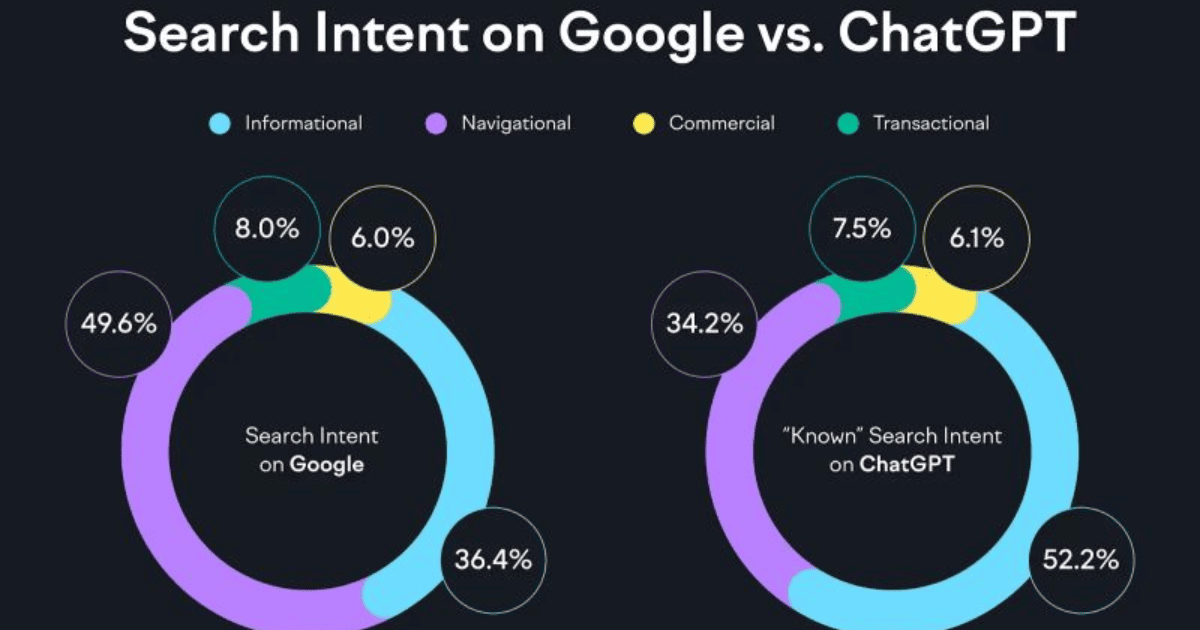
More people are using AI tools to search, not just Google.
They ask ChatGPT before buying something. They ask Gemini for local business ideas. They ask Perplexity to compare options. ChatGPT alone now has more than 122 million weekly active users, according to OpenAI. Perplexity processes over a billion search queries every month. These are not small numbers. This is where your customers already are. This changes how customers find you.
In the past, you needed to rank on Google. Now, you also need to show up when AI tools answer questions. If you are not there, AI simply recommends someone else.
We have seen this happen with real clients. Their business was doing well on Google, but AI tools never mentioned them at all. That meant lost customers they did not even know about.
The good news is this. Small businesses can compete here. AI tools do not only trust big brands. They trust clear, honest, well-organized content — no matter who wrote it.
This is why AEO is not optional anymore. It is becoming as important as regular SEO. Ranking on Google is still important too—read why SEO matters for small businesses. If you haven't already.
How ChatGPT and AI Search Choose Which Websites to Recommend
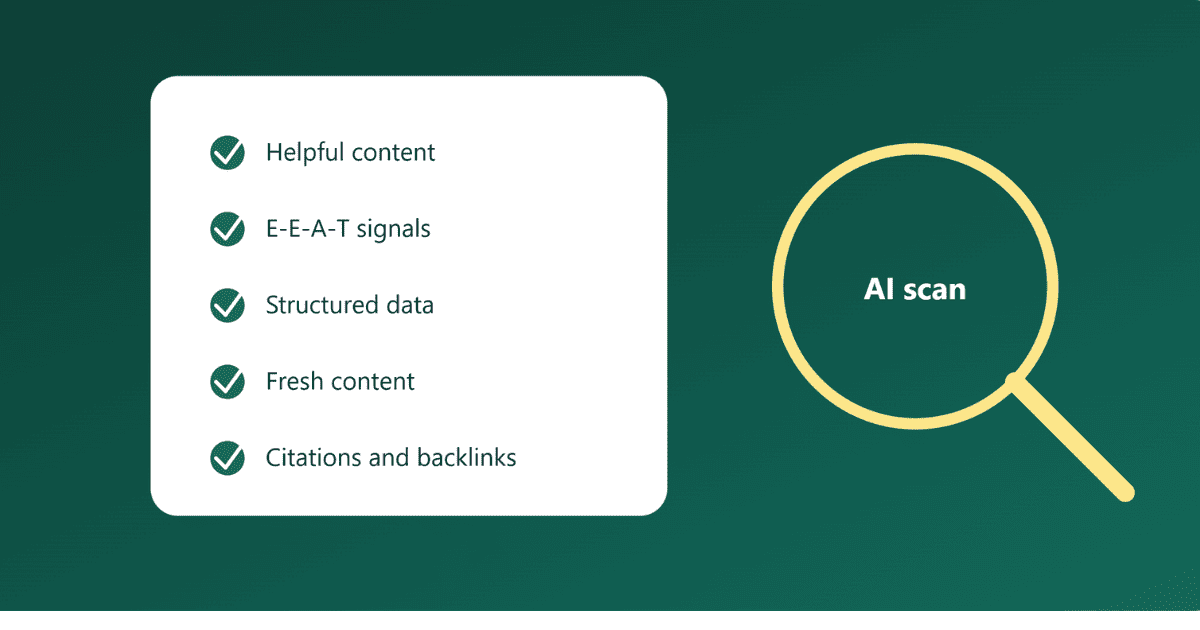
AI tools do not pick businesses randomly. They look for specific signals before they trust and recommend a website.
Helpful content.
AI looks for content that actually answers the question. Not fluff. Not filler. Just clear, useful information a real person would find helpful.
E-E-A-T.
This stands for Experience, Expertise, Authoritativeness, and Trustworthiness. AI checks if real people wrote the content, if they know what they are talking about, and if the information can be trusted.
Structured data.
This is extra code added to a website that helps AI understand exactly what the content means. It makes your content easier for AI to read and use correctly.
Brand authority.
AI notices if a business is well known and respected online. The more your brand is mentioned positively, the more AI trusts it as a source.
Fresh content.
AI prefers content that is updated and current. Old, outdated pages are less likely to get picked, especially for topics that change often.
Citations and backlinks.
When other trusted websites link to you or mention your business, it tells AI that you are credible. This is one of the strongest trust signals AI looks for.
Together, these signals tell AI one simple thing: can this business be trusted enough to recommend?
Step-by-Step Guide to Rank on ChatGPT and AI Search
Here are simple steps you can start using today.
1. Research user questions.
Find out what your customers actually ask. Use Google's "People Also Ask" section, or just think about the common questions you get from customers every day. Write your content around real questions.
2. Write in a conversational tone.
Write the way you talk. Short sentences. Simple words. AI tools prefer natural language over stiff, formal writing.
3. Add FAQ schema.
This is a small piece of code added to your FAQ section. It helps AI clearly see your questions and answers, making it easier to pull your content into their responses.
4. Show a real author bio.
Add your name, photo, and a short bio to your articles. This proves a real person with real experience wrote the content, not just a machine.
5. Improve user experience.
Make sure your website loads fast and works well on phones. A slow, hard-to-use website loses trust with both users and AI.
6. Build backlinks.
Get other trusted websites to link to your content. Each link acts like a vote of confidence, telling AI your business is credible.
7. Optimize for entities.
Make sure your business name, services, and location are mentioned clearly and consistently across your website and other platforms. This helps AI understand exactly who you are and what you do.
8. Update your content regularly.
Go back to old articles and refresh them with new information. Fresh content earns more trust than content that has not changed in years. Small, steady steps like these add up. You do not need to do everything at once.
ChatGPT vs Google AI Overviews vs Perplexity
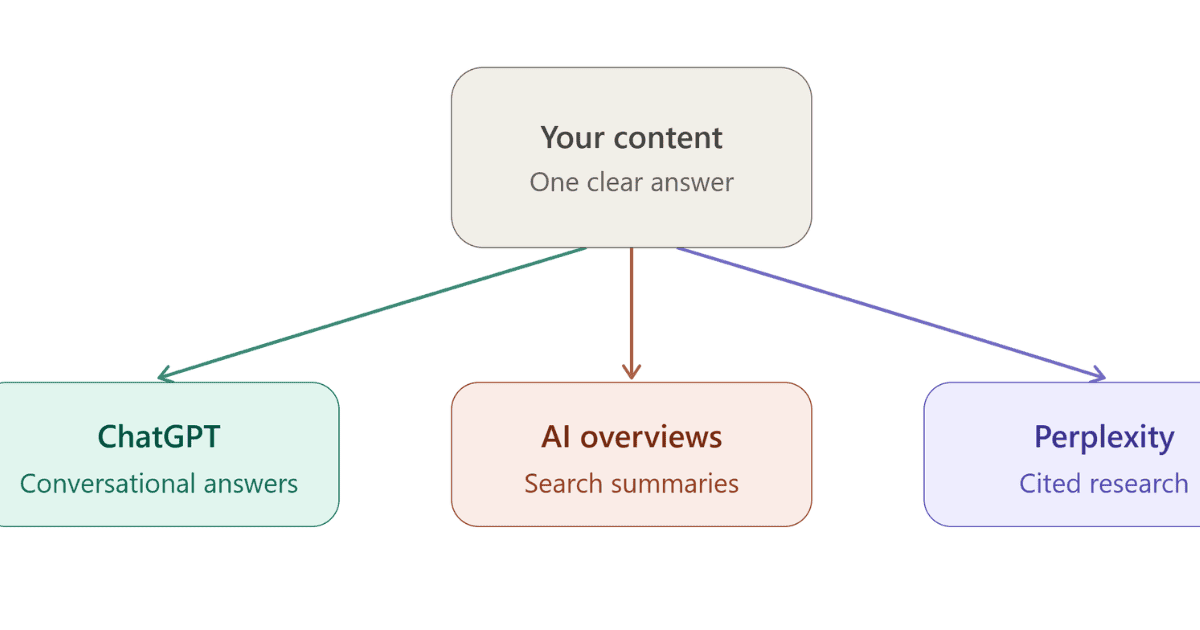
Each AI tool works a little differently. Here is a simple comparison to help you understand what each one prefers.
Feature | ChatGPT | Google AI Overviews | Perplexity |
Uses live search | Yes | Yes | Yes |
Shows sources | Sometimes | Yes | Yes |
Best for | Conversational answers | Search summaries | Research |
Best content type | FAQs, guides | Strong SEO content | Recent, sourced data |
Gemini works closely with Google's own search data, so strong SEO content tends to help there too. Claude focuses more on long-form, careful reasoning, and currently shows fewer live sources compared to the others. The takeaway is simple. If your content is clear,
Google has also published its own guidance on optimizing content for AI-powered search—worth checking directly from the source.
Common AEO Mistakes to Avoid
Many businesses try AEO but make small mistakes that hold them back. Here are the most common ones.
Stuffing keywords everywhere.
Repeating the same phrase again and again does not help. AI tools notice unnatural writing and trust it less, not more.
Writing for search engines instead of people.
If your content sounds robotic or overly formal, both users and AI tend to skip past it.
Skipping the FAQ section.
Without clear questions and answers, AI has a harder time pulling direct information from your page.
No real author information.
Content with no name or bio behind it looks less trustworthy to AI tools. Ignoring page speed. A slow website frustrates users and gets pushed aside by AI tools that prefer fast, reliable pages.
Copying content from competitors
AI can detect repeated or unoriginal content easily, and it will not recommend it.
Letting content go out of date.
Old prices, old services, or old information make AI (and users) trust your page less.
Avoiding these simple mistakes puts you ahead of most small business websites already.
How Our SEO Agency Helps Businesses Rank in AI Search
After working with small business websites for several years, I have found that AI tools consistently favor websites that give clear answers, show real expertise, and stay updated. Businesses that follow this get noticed — the rest get skipped.
— Muhammad Nadeem, Founder, SEO by Nadeem
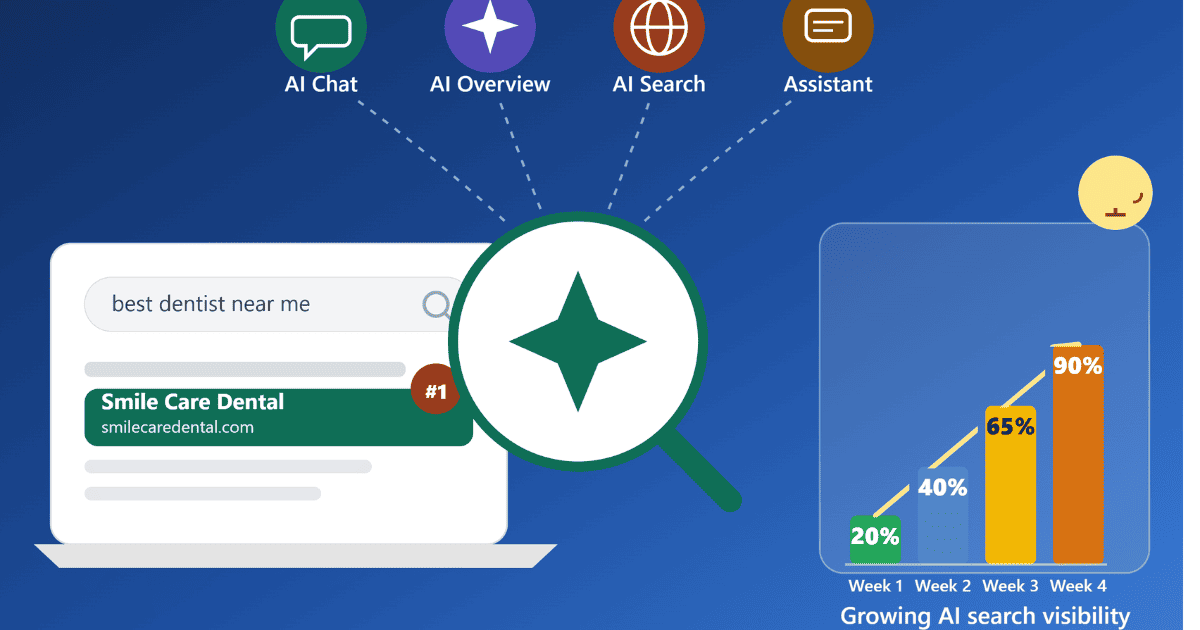
One example: We built a website for a dentist and worked on local SEO to help him rank in his area. Within a few months, when people nearby searched for a dentist near them, his website started showing up. He is still one of our clients today.
Getting your business seen by AI tools takes more than one blog post. It takes the right structure, the right content, and steady work over time.
At SEO by Nadeem, we help small businesses do exactly this. We look at your website, find what is missing, and fix it step by step. This includes writing content the right way, adding proper schema, building your author profile, and getting your business mentioned across trusted sites.
We also handle the technical side, so your website loads fast and works well on every device. AI tools notice this, and so do your customers. Every business is different, so we do not use a one-size-fits-all plan. We build a strategy based on what your business actually needs, then track the results together.
If you want to see where your website currently stands, check out our SEO services, and we will walk you through exactly what needs improvement.
FAQs
How long does AEO take to show results?
Most businesses start seeing early signs within 4 to 8 weeks, similar to SEO. Full results usually build over 3 to 6 months as your content gains more trust and citations.
What is AEO?
AEO stands for Answer Engine Optimization. It means writing your content so AI tools like ChatGPT, Gemini, and Perplexity can easily read it, trust it, and use it to answer questions.
Does AEO require technical skills?
No. Most AEO basics, like writing clear answers and adding an FAQ section, can be done without any coding. Some steps, like schema markup, may need a developer's help.
Can small businesses really compete with big brands in AI search?
Yes. AI tools do not only trust big brands. They trust clear, honest, and well-organized content, no matter the size of the business behind it.
Do I need SEO if I already have AEO?
Yes, you need both. SEO and AEO work together. Strong SEO often helps AI tools find and trust your content in the first place.
Which AI tools should I optimize for?
Focus on ChatGPT, Google AI Overviews, and Perplexity first. These are the most widely used right now, and the same good practices work well across all of them.
Is AEO different from SEO?
Yes. SEO helps your website rank as a link in Google. AEO helps your business get mentioned directly inside an AI-generated answer, sometimes without the user clicking anywhere.
How do I know if my business is showing up in AI search?
Try asking ChatGPT or Perplexity questions related to your business and see if you are mentioned. Some tools also offer visibility tracking to monitor this over time.
Conclusion
AI search is not a passing trend. It is changing how people find businesses every single day. ChatGPT, Google AI Overviews, Gemini, and Perplexity are becoming the new front door to search. If your business is not set up to be found there, you are already missing customers you don't even know about.
The good news is simple. You do not need a big budget or a huge team to show up in AI search. You need clear content, honest information, and a website that AI tools can trust. Start small. Answer real questions. Show your experience. Keep your content updated. These steps add up over time.
AI search will keep growing in the coming years. Businesses that adapt early will have a real advantage over those who wait. If you want help setting up your website for AI search the right way, get a free SEO audit, and we will show you exactly where you stand.
Ready to Show Up in AI Search?
Setting up your website for AEO can feel like a lot to handle on your own. You don't have to figure it out alone.
At SEO by Nadeem, we offer a free SEO and AEO audit for your website. We will check how your business currently shows up on Google and on AI tools like ChatGPT and give you a clear list of what to improve.
No pressure, no obligation. Just honest feedback from people who do this every day. Get your free SEO and AEO audit today, or message us directly on WhatsApp to talk about your website.